



Australia is no stranger to extreme weather events, with floods posing a significant threat to communities, infrastructure, and the economy each year. As climate patterns continue to shift, the need for reliable and accurate flood monitoring solutions has become more critical than ever.
Traditional flood monitoring methods, such as manual river gauges and delayed reporting systems, are no longer sufficient in today’s fast-paced environment. Modern solutions now leverage real-time data, automation, and smart technologies including IoT (Internet of Things), artificial intelligence (AI), and advanced sensors to provide early warnings and enable proactive responses.
Why Flood Monitoring Solutions Are Critical for Australia?
Flooding can have devastating consequences, from property damage and infrastructure disruption to risks to human life. In both urban and regional areas, the ability to monitor water levels in real time allows authorities and communities to act quickly and minimise impact.
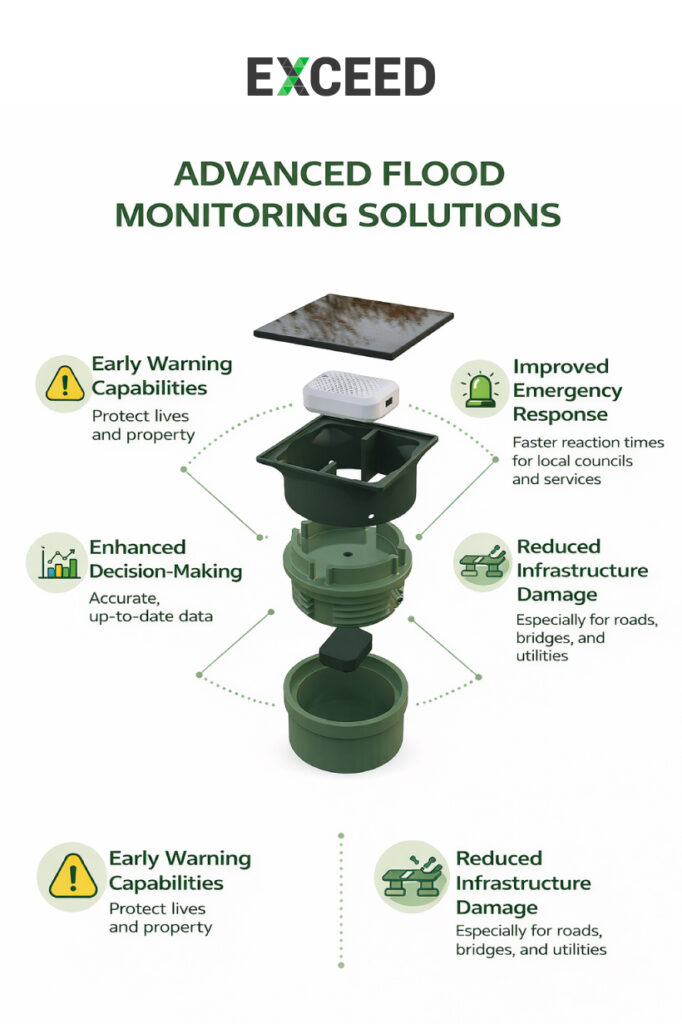 Key reasons why advanced flood monitoring solutions are essential include:
- Early warning capabilities to protect lives and property
- Improved emergency response times for local councils and services
- Reduced infrastructure damage, particularly for roads, bridges, and utilities
- Enhanced decision-making through accurate and up-to-date data
With increasing population growth in flood-prone regions, investment in smarter monitoring systems is no longer optional; it’s a necessity.
Key Technologies Powering Modern Flood Monitoring Solutions
IoT-Based Flood Monitoring Systems
IoT-enabled systems use a network of connected sensors to collect and transmit real-time data on water levels, rainfall, and environmental conditions. These systems are often solar-powered, making them ideal for remote and regional locations across Australia.
They offer:
- Continuous monitoring without manual intervention
- Remote accessibility via cloud-based dashboards
- Scalable deployment across multiple sites
Radar Water Level Sensors
Radar sensors are widely regarded as the gold standard in flood monitoring. Mounted above water, they provide non-contact measurement, ensuring reliability even during severe flooding.
Benefits include:
- High accuracy (up to 1cm precision)
- Minimal maintenance requirements
- Consistent performance in harsh weather conditions
AI-Powered Camera Monitoring
AI-driven camera systems add a visual layer to flood monitoring by detecting water levels and identifying flood conditions in real time. These systems can automatically verify events such as road flooding or rising waterways.
Key advantages:
- Real-time visual confirmation
- Automated detection and alerts
- Enhanced situational awareness for authorities
Real-Time Alert & Communication Systems
Modern flood monitoring solutions integrate with alert systems that notify stakeholders instantly via SMS, email, or voice calls.
Features include:
- 24/7 monitoring and alerting
- Integration with emergency response systems
- Customisable alert thresholds
Satellite & 5G-Enabled Monitoring
Emerging technologies are enabling flood monitoring in even the most remote parts of Australia. Satellite and 5G connectivity ensure uninterrupted data transmission where traditional networks may not be available.
These innovations support:
- Wide-area coverage
- Reliable communication during disasters
- Scalable national monitoring networks
Leading Flood Monitoring Solutions & Providers in Australia
Australia is home to a range of innovative flood monitoring providers delivering advanced solutions for councils, utilities, and businesses.
IoT & Sensor-Based Solutions: These systems utilise radar, ultrasonic, and pressure sensors to monitor waterways, drainage systems, and flood-prone zones with high accuracy.
AI & Camera-Based Platforms: Smart camera systems combine AI analytics with live video feeds, providing both detection and verification of flood events.
Integrated Monitoring & Alert Services: Comprehensive platforms deliver real-time data, automated alerts, and detailed reporting, helping organisations respond quickly and effectively.
Flood Monitoring for Different Applications
Industrial & Government Use: Large-scale systems are used to monitor rivers, bridges, and road networks. These solutions help manage flood risks and ensure public safety.
Agricultural Applications: Farmers use flood monitoring systems to track water levels in dams, tanks, and irrigation systems, helping protect crops and livestock.
Residential & Commercial Protection: Smaller-scale solutions, such as leak detectors and smart sensors, provide early warnings for homes and businesses, preventing costly damage.
Introducing Next-Generation Flood Monitoring Solutions
Challenges with Traditional Systems
Older flood monitoring setups often involve:
- Complex installation processes
- High upfront and maintenance costs
- Limited scalability and integration
These limitations have driven the demand for smarter, more efficient alternatives.
The Shift to All-in-One Smart Solutions
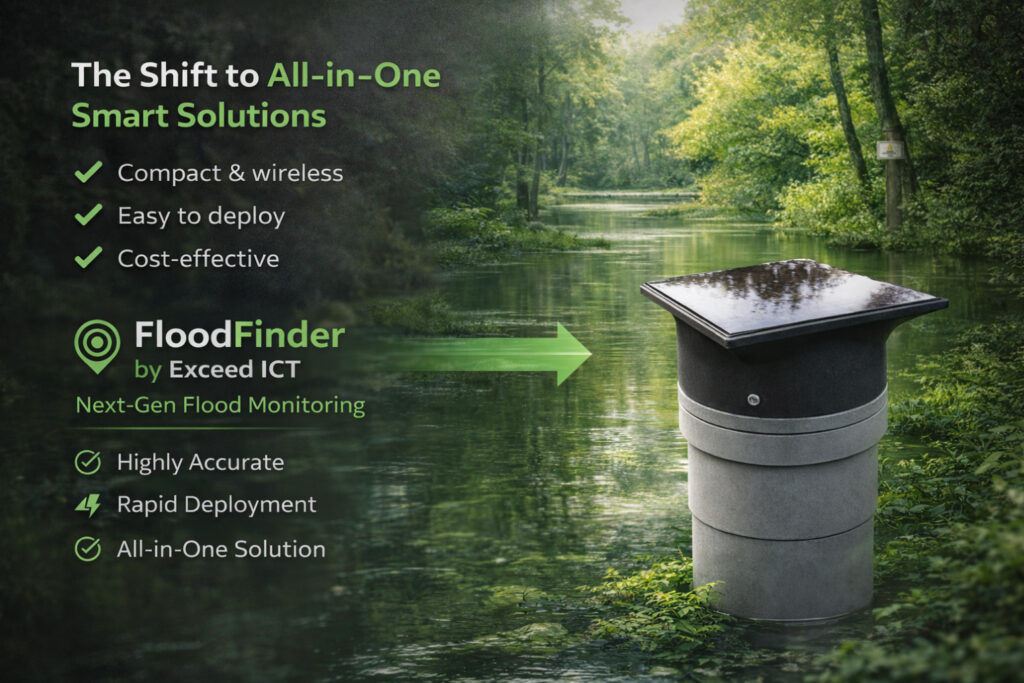 Modern flood monitoring solutions are designed to be compact, wireless, and easy to deploy. These systems integrate multiple functions into a single device, offering a seamless and cost-effective approach.
One such innovation is FloodFinder by Exceed ICT, a next-generation solution designed for accuracy, simplicity, and rapid deployment.
Key Features of Modern Flood Monitoring Systems
Today’s advanced systems offer a range of powerful features:
- Real-time monitoring and analytics
- High-precision water level detection (up to 1cm)
- Solar-powered operation for remote deployment
- Global connectivity (LTE-M, NB-IoT, 4G/5G)
- Automated alerts via SMS, email, and push notifications
- Durable, weatherproof design for harsh environments
Benefits of Advanced Flood Monitoring Solutions
Implementing modern flood monitoring systems delivers significant advantages:
- Faster emergency response times
- Reduced risk of damage to infrastructure
- Improved community safety and resilience
- Lower operational and maintenance costs
- Data-driven insights for better planning and management
The Future of Flood Monitoring in Australia
The future of flood monitoring lies in smarter, more connected technologies. AI and machine learning will enable predictive analytics, helping authorities anticipate flooding before it occurs.
With the rollout of 5G networks and continued advancements in IoT, Australia is moving towards a fully integrated flood monitoring ecosystem that enhances safety and sustainability.
Choosing the Right Flood Monitoring Solution
When selecting a flood monitoring system, it’s important to consider:
- Location – urban vs remote environments
- Connectivity – availability of network coverage
- Integration – compatibility with existing systems
- Scalability – ability to expand as needed
- Budget – upfront and ongoing costs
Choosing a reliable and accurate solution ensures long-term effectiveness and peace of mind.
Conclusion: Building a Safer Future with Smart Flood Monitoring
As flood risks continue to grow, investing in advanced flood monitoring solutions is essential for protecting lives, infrastructure, and communities across Australia.
By embracing modern technologies such as IoT, AI, and real-time alert systems, organisations and individuals can take a proactive approach to flood management. Innovative solutions like FloodFinder are paving the way for a smarter, safer, and more resilient future.
FAQs About Flood Monitoring Solutions
What are flood monitoring solutions?
Flood monitoring solutions are systems designed to detect, measure, and report water levels in real time, helping to predict and manage flood events.
How do IoT-based flood monitoring systems work?
They use connected sensors to collect environmental data and transmit it to cloud platforms, where it can be analysed and monitored remotely.
What is the most accurate method for measuring water levels?
Radar sensors are considered highly accurate, offering non-contact measurement with precision up to 1cm.
Can flood monitoring systems work in remote areas?
Yes, many modern systems use solar power and satellite or low-power wide-area networks (LPWAN) to operate in remote locations.
Are there solutions for residential properties?
Absolutely. Homeowners can use smart leak detectors and water sensors to monitor and prevent water damage.
Call us on 1300 832 639 or simply search “Exceed ICT” on Google Maps to find a location near you and connect with our team today.
We also provide
Telecoms Expense Management, Device Deployment, Mobile Fleet management, Telstra mobility Managed Services.
Improve Business Core values, Business Consulting, Network Management, Telstra Expense Management and many more Services.